
Well-crafted rubrics can outline expectations, segment assignments into functional categories, and standardize evaluation by assigning point totals to (or required performance levels for) defined assignment criteria.
That said, rubrics are not terribly effective mechanisms for aiding the creation or evaluation of academic expository essays.
Before I explain why, I want you to consider the sheer volume of (non-rubric) resources you are given for writing assignments:
- You have multi-page assignment sheets that outline the expectations for each paper. (These expectations are the criteria that would be listed in a rubric.)
- You have class periods that break down specific steps of our writing projects and set goals for completion. (The fancy term for this “breaking down” is pedagogical scaffolding).
- You have handouts that offer step-by-step guidance for how to shift an observation into an interpretation, and how to turn a draft into a final paper. (The handouts outline the course’s ideal conception of writing performance and show you how to reach that ideal.)
- Most importantly, you can get individualized feedback if you submit a draft of your essay to me at least 48 hours in advance of the paper’s due date.

Why rubrics are inadequate aids for advanced writing
There is no way to assign discrete and non-varying values to the essential elements of advanced expository essays. For an advanced expository essay to function, each essay element must be evident and work in concert with the other basic parts of the paper to be fully legible. Any fundamental disruption to one element could destroy the entire essay.
Think of an expository essay as a running car. We all know cars have batteries, gas tanks (that should be filled with gas), starter motors, and alternators. To function, a car needs all these parts working together at the same time. Having a full tank of gas won’t help you if your battery dies. A new battery can’t repair your broken starter motor. A fixed starter motor won’t keep your battery charged while the car is running—you need an alternator for that. If one of these core elements is missing (or faulty), the car isn’t starting. There is no way it can run.
Academic writing also requires basic components to work in tandem to properly function. Consider the table below, which lists 15 “singular” problems that can individually fail an entire paper:
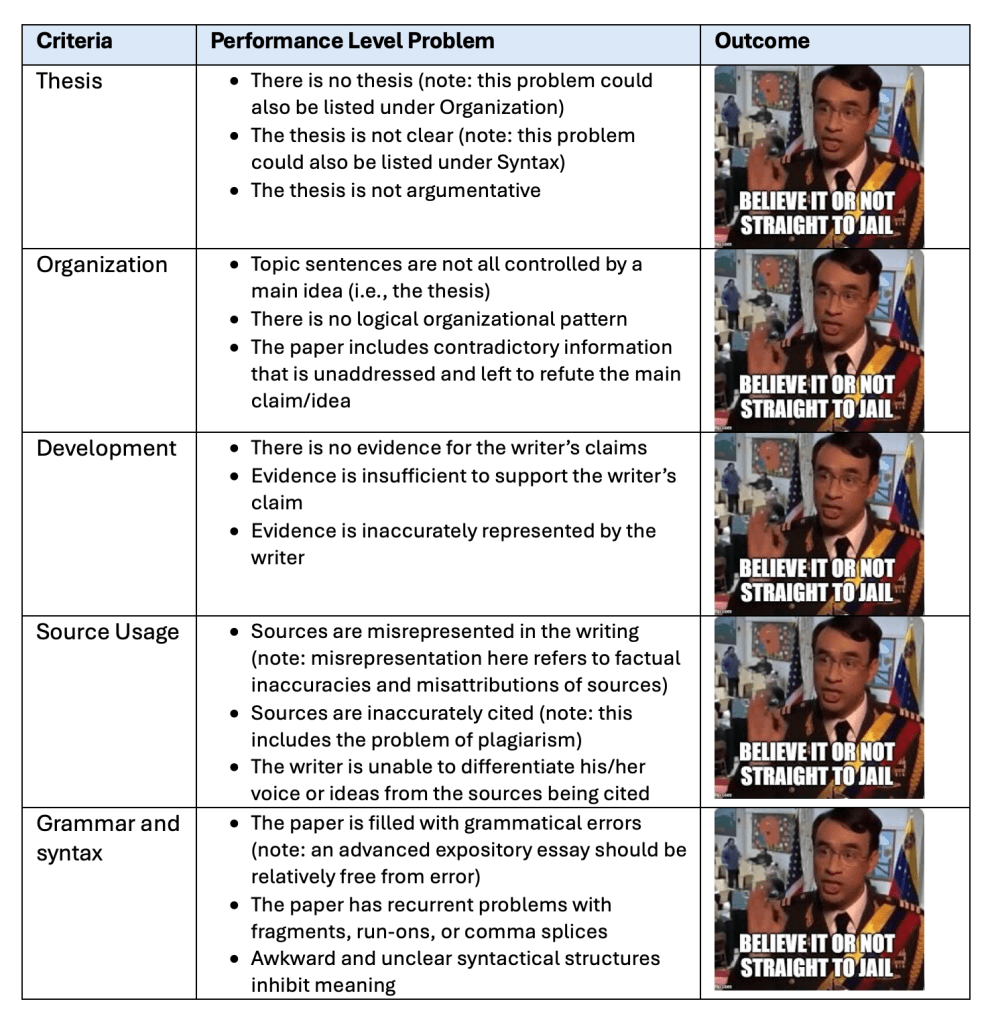
Great grammar and excellent syntax won’t make up for the lack of a thesis, just as a fabulous thesis can’t undo the damage of source misattribution. You need everything properly working together.

Keep this in mind: you already live comfortably without rubrics for tests because you understand testing formats. What you’re really interested in is the final score. Take the same stance when you approach the expository essay and focus on higher-order issues to attain your desired success level!