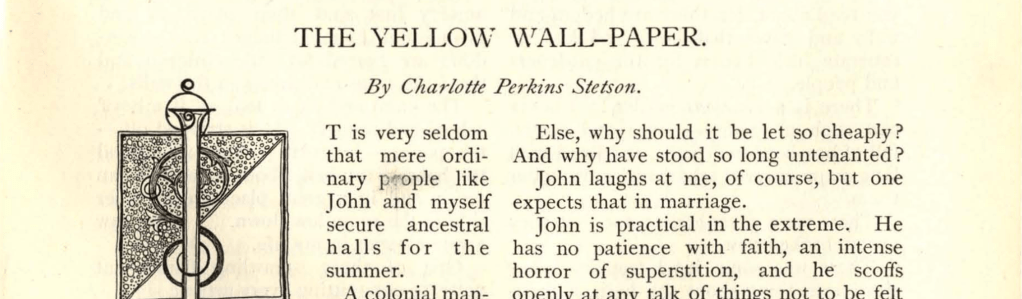

Begin by scanning the length:
Short stories are “short” because they rely on narrative compression and ellipsis. What constitutes “short” can vary. Is the story 300 words or less (so a species of micro-fiction)? Somewhere between 300 and 1000 (a short version of a short story)? Five thousand (5000) words or more (a relatively long short story)? Use the length to guide your expectations of narrative development.
Try to make sense of the title:
Pay particular attention to the precise wording (and formatting) of the title. What does this prepare you to expect? Is this preparation then realized in the reading experience? [Does this understanding complicate or refute your initial expectation? Upon reflection, what further understanding can you apply to the title?]
Then proceed to a closer analysis, asking the appropriate questions:
Properly identify point-of view (a.k.a. first-person, second-person, or third-person): Is the narrator a participant in the story being relayed? The central character (if there is one)? An observer of some sort? Or is the narrator an agent removed from or above the storyworld itself? [Does the voice of the narrator ever blend with the voice of a(nother) character in the tale? If so, where and to what effect?]
Examine the language of the narrator. Does the narrator make use of unusual syntax (word order) or diction? What can you say about the personality, circumstances, attitude, and tone of this voice?
What type of information does this narrator supply? Is this information factual, evaluative, or some combination of the two? What information does the narrator include? What information is omitted? Does anything in the presentation (or omission) of information cause you to question the reliability of the narrator?
How specific is the setting of the story? Do you know where the tale takes place? When the tale takes place? How important is the setting to the presentation of the story?
Note the number of characters and the ways they are characterized. Are characters described by the narrator, defined through action, defined through dialogue, or characterized via a variety of means? Is there a central character (if so, what is the relation between the central character and the narrator; could the central character be the narrator)? Which characters are flat? Which are round?
Look for patterns (i.e., motifs). Does the narrative repeat specific words or phrases? Use similar structures to relay the same type of information (e.g., consistently use epithets in place of names)? What imagery is recurrent?
Outline the plot. In what order are events relayed? In chronological order or not? How does this order affect your understanding of the story? Are the actions primarily external (i.e., able to be objectively observed and verified in the story world) or internal (i.e., the emotion experience of individual characters)?
Define denouement: What is resolved in the end? What “single effect” (in Poe’s terminology) is achieved? How might the “single effect” (or dominant impression) reinforced in the conclusion translate into a message or theme?

