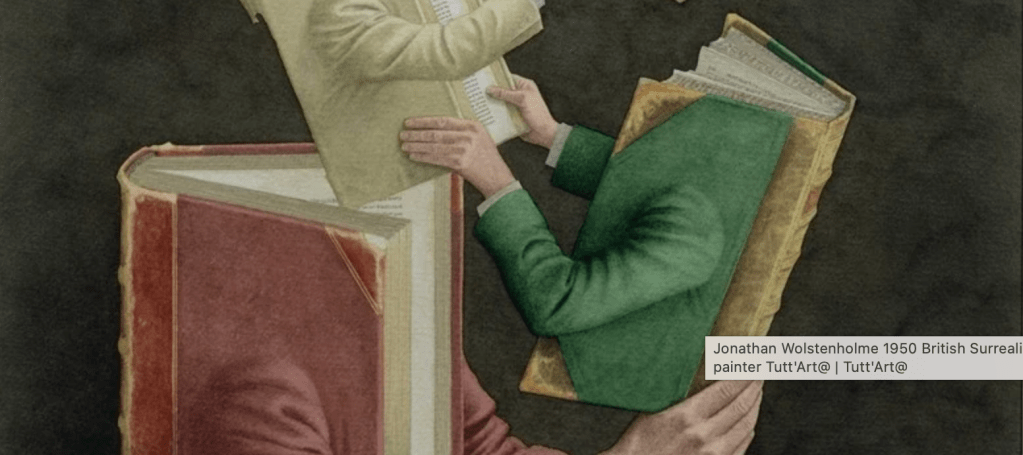
Any time a piece of writing references another, it creates a textual connection. Citations are formal methods of acknowledging this connection that provide pathways between texts. A person (or, in the case of the illustration, a book) that encounters a reference to another piece of writing while reading can follow the citation in the text to the original source.
Not all citations are the same. Hyperlinks, common in online texts written for popular audiences, take readers directly to a virtual site. Bibliographic entries, common in academic writing, provide formatted information regarding authorship, title, publication venue and date, and date of access.
In an era of hyperlink access, full bibliographic entries can seem unnecessary. That is only true, though, if you prioritize ease of access over accuracy and reliability. Consider this link to a virtual exhibition of Jonathan Wolstenholme’s “Books on Books” series. When you click on it, you can scroll through many Wolstenholme’s surreal paintings, including the one used as a header on this page. This link, though, doesn’t provide you with the title of the painting or the date the painting was completed. You also don’t know who took the picture of the work, and you have no way to investigate what the curation process was. In consequence, you don’t know if this is an accurate, high-quality image of the painting, or even if this is the latest version of the visual piece. If the link breaks or you lose access to the internet, your reference is gone, and you have no other way of retrieving it.
The working parts of full a bibliographic entry
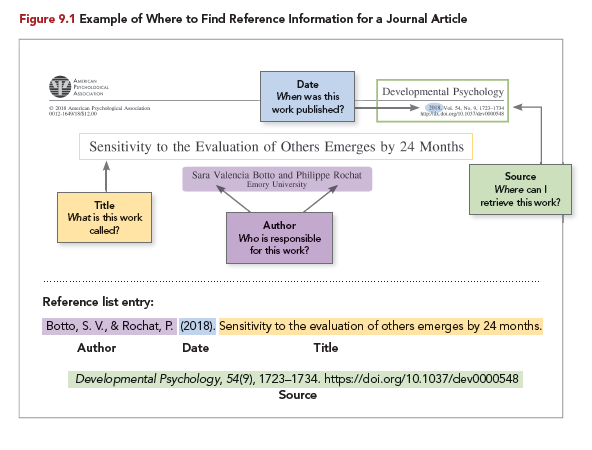
If you brush aside fine formatting distinctions, you’ll see that all bibliographic entries include 4 fundamental elements, which we can refer to as the “who, what, where, and when” of reference.
- Who: the entity that created the source cited (an author, editor, artist, musician, etc.)
- What: the official name of the specific source cited (e.g., the title of an article, the name of a composition)
- Where: information on the site of access (publication information for print materials; URLs or DOIs for online materials; physical location for live performance, interview, etc.)–labeled here as a “where” because it is where the information can be retrieved
- When: the date of publication or creation (note: this may also include when the reader/ researcher accessed the source material)
The official APA site identifies these 4 fundamental elements using slightly different terms:
The MLA chooses to identify 9 possible elements to account for the variation in “where” (what they call the container). Notice that MLA’s #1 and 2 use the same category names as the APA, and that APA’s “date” is MLA’s #8 (what we are referring to as “when”). MLA’s #3-7 and 9 are what APA refers to as a “Source” (which were are referring to as a “where”).
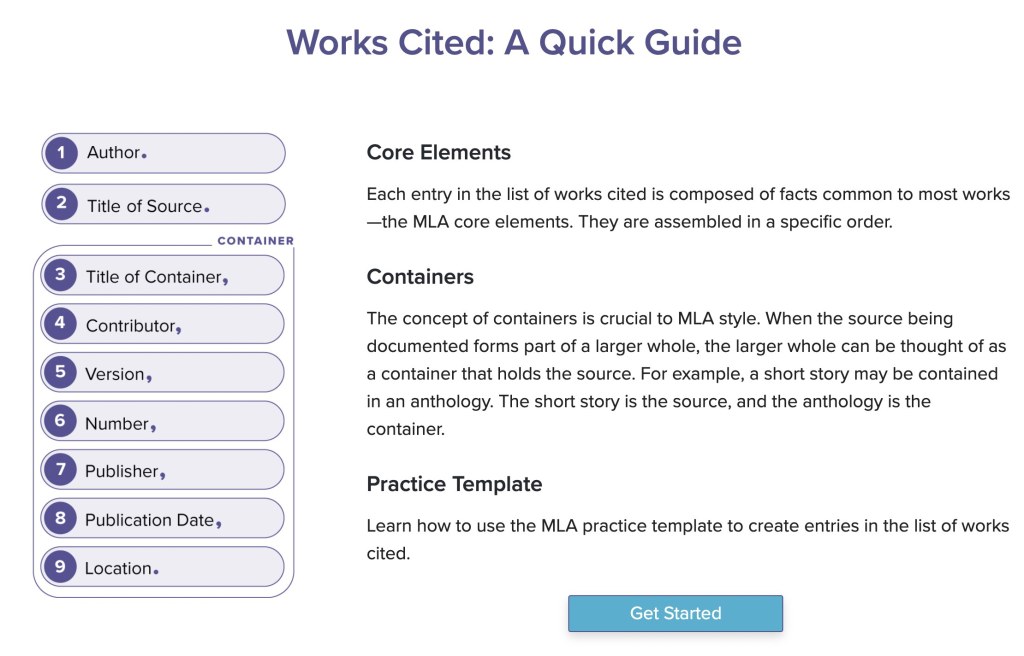
As the distinction between graphic depictions of entry basics demonstrates, there are clear variations in style, but don’t let this divergence fool you. All citational forms are designed to record the same core elements, elements which will allow readers to “go straight to the source,” should they wish to do so.
The “trick” to using any citational style is the ability to place the original source in the right category so that the specific rules for that category can be followed.
How to successfully perform scholarly citation
- Determine which citational style you are expected to use in coursework.
- Gain access to the official style source (keeping in mind that open access online resources from major organizations, like the MLA or APA, will never include every last particular [because they have style guides and electronic access to sell!]).
- Avail yourself of library resources (every university library, including our own, has physical copies of the latest style guides and information on how to properly cite sources).
- (If using MLA or APA), bookmark OWL at Purdue. Marvel at everything the good folks in West Lafayette IN have provided you.
- Supplement your access to the official style guides and library resources with reputable online citation generators (e.g., Zotero, BibMe, or Citation Machine) that can help you quickly and efficiently shift between citation styles.
- Remember that citation styles do occasionally modify, update, or change (so check your dates and be up to date!).
- Remind yourself that citational styles are designed to ease and facilitate research. Standardization aids clarity and comprehension, and tech continues to streamline the process. (Citation generators and updates in word processing software are there to further reduce burdens–if you can properly categorize your sources and follow steps 1-3, your computer can do a lot of the work for you!)
- Never forget that you are the final check. ‘Doing a lot of the work’ is not the same thing as doing all of the work–even good automatic citation generators on library websites can make formatting errors. (You know problems can occur when you’re formatting documents or uploading to BlackBoard–those generators can have similar glitches!)
And, if you’d rather have some of this information in short video form, here you go:

