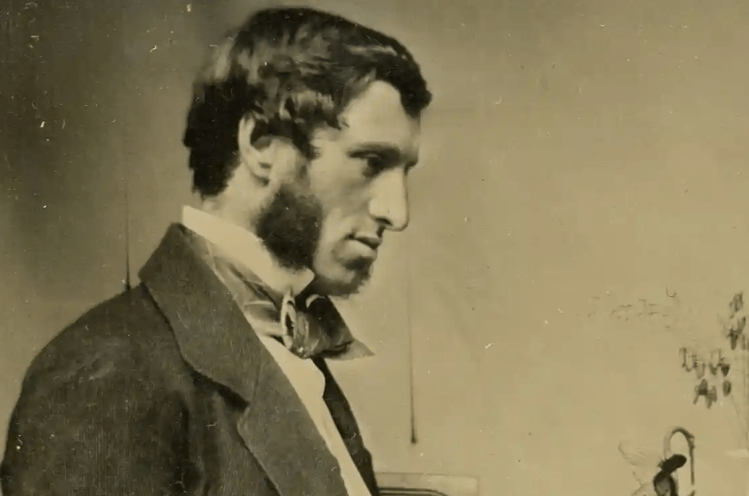
Matthew Arnold, image courtesy of The Guardian 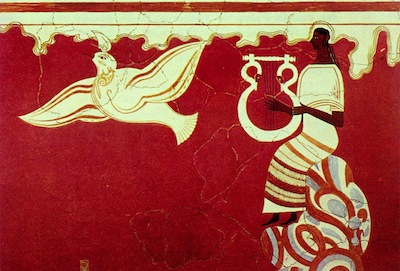
(Original web sources for images: Matthew Arnold via The Guardian and Rhapsode via “Music for the Listener”)
Plato’s “Ion” focuses on the merits of a profession for which there is no direct modern equivalent, the rhapsode. These skilled story tellers share much in common with other ancient performers–actors and musicians–but the so-called “song stitchers” focus exclusively on the work of selected poets, reciting verse to a (hopefully willing) audience.
Modern readers of Platos’ early dialogue have likened the hapless recipient of Socrates’ wit to a contemporary literary critic. Evidence for this (ancient) analogue is present at the start of the exchange, when the philosopher clearly states: “no man can be a rhapsode who does not understand the meaning of the poet. For the rhapsode ought to interpret the mind of the poet to his hearers, but how can he interpret him well unless he knows what he means?”
Admittedly, the playful exchange in “Ion” is by no means reducible to what we would now term literary criticism. The dialogue’s exploration of divine inspiration touches on the origin (or source) of art as well as humanity’s relation to higher powers (in other words, religion). That said the work’s implicit articulation of the value of the rhapsode’s performance, and expertise this performer may (or may not) evidence, does provide a space within which we can productively debate the function of literary criticism. And we will enter into this debate armed with the critical work of Matthew Arnold, the Victorian intellectual who famously defended “The Function of Criticism at the Present Time.”
Defining the terms of the debate
Before we can engage in a debate, we will have to read our source texts closely, so that we can comprehend their specific points. Annotation exercises and structured class discussions will aid this effort.
Once we have a firm understanding of each text, we will workshop ways to deploy elements of Arnold’s argument as counters to Socrates’ devaluation of the rhapsode. We will use this counterargument/redress as a way to make a compelling case for the importance of literary criticism and the knowledge it provides. Our final case will be made in a carefully crafted work of academic expository prose, 5+ pages (1250+ words) in length.
Magnetically connecting the terms and paper
Our engagement with “Ion” will serve a very modern end: to affirm the importance of critical interpretation in the present age. Like Arnold, we will ultimately assert that criticism has value because it allows human culture to flourish. (And, yes, I am mandating an iteration of this thesis–and if you can’t endorse this particular thesis, you may want to ask yourself why you are in this degree program in the first place.)
Before we begin drafting, we should openly acknowledge that neither Plato nor Arnold is going to make an easy argument for us, as each starts from the assumption that the bulk of what English majors do (criticism) is necessarily inferior to the production of literary art. (Socrates and Arnold are both quite clear on this point.) Each author, though, also operates from the assumption that literature needs to be thoroughly and critically appreciated. We are going to draw on this shared sense of appreciation to argue on behalf of our profession.
Why this critical function in our present time?
Take a moment to consider the odds against you in the professional marketplace. Your training provides you with the soft skills and creative problem solving abilities employers say they want, but you can’t just go into a job interview discussing that which fostered your intellectual development (discussions of transcendent meaning and imaginative expression) and expect to be taken seriously. You will have to tailor your message to the transactional nature and immediate needs of the current job market, selectively making reference to the importance of your foundational knowledge (knowledge that you independently possess and can use to great effect) if you are to have positive impact at the present time.
Matthew Arnold will provide you with rhetorical mechanisms for discussing your positive impact, mechanisms that should be quite convincing, considering the fact that they can address the reservations and concerns of none other than Socrates. (And, honestly, what better way for you to make a case for your professional value than to use the canon itself to justify the societal worth of your intellectual endeavors?)
So take control of the discourse, and divert energy from the haters (who are going to do what they do).
 Helga's Hub