
As we discuss the “future of English,” we are going to make a case for a literary work we love. This case will draw on our literary knowledge and expertise while it allows us to do something we don’t often get the opportunity to do in literature classes–focus on our affective response.
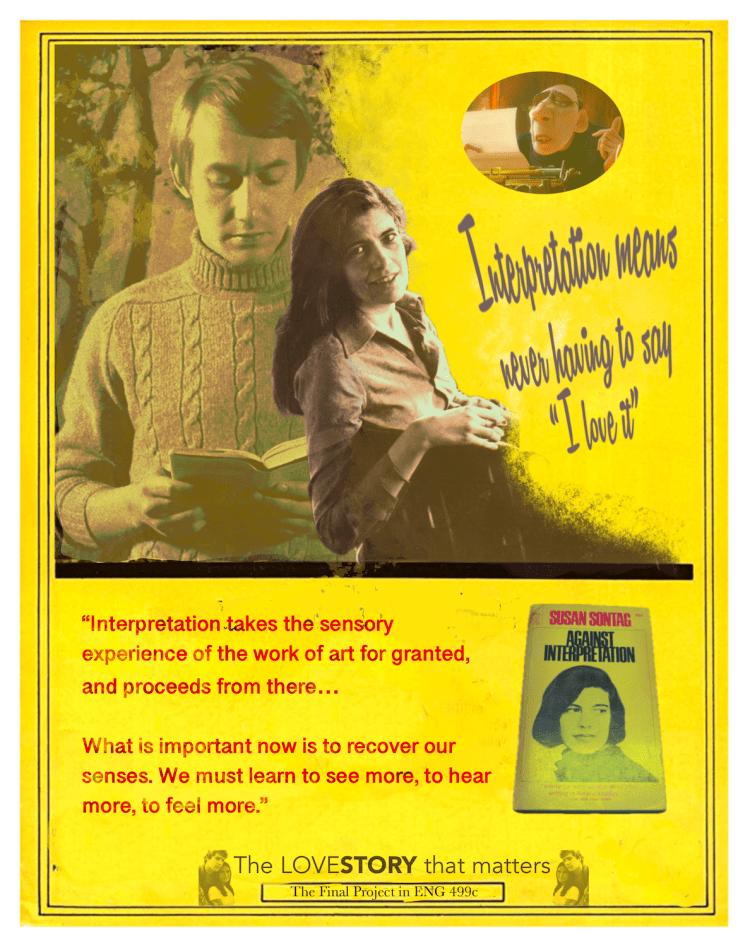
This project is inspired by Susan Sontag’s famed essay “Against Interpretation,” which strives to elevate “the sensory experience of the work of art.” Unlike Sontag, though, we will still assume there is content in art, and we will use Elaine Auyoung’s “What We Mean by Reading” to help us articulate the readerly approaches that facilitate our enjoyment of the text.
To prepare for this project, we will read selections from Rita Felski’s Hooked, a study that explores the emotional attachment that fosters aesthetic experience. We will also read Virginia Woolf’s “How Should One Read a Book?,” a familiar essay that encodes an affective approach in its breezy delineation of “good” fiction.
Assignment particulars:
Recovering Our Senses is a project comprised of two parts: (1) an academic essay that expresses your love for a particular work of literary work (worth 100 points) and (2) a presentation, post, or original media creation that “spreads the word” about your literary artifact to a popular audience (worth 50 points).
What counts as literature for this assignment: Literature here means a published work of fiction (which may exist in poetic or dramatic form). This published work does not have to have secured canonical status. The only mandated criterion is that the work exists in a verifiable version that can be properly cited. We are making a specific case for a particular literary artifact. We are not celebrating general tropes, myths, or legends.
The academic essay should:
- be 1250+ words in length.
- cite Elaine Auyoung’s “What We Mean by Reading,” using that article to outline the reading practices that facilitate the enjoyment of the literary text.
- demonstrate an awareness of both the form and content of the chosen work (note: writers are not required to craft a formal analysis, but they should know and be able to properly identify the aspects of the work that they particularly love).
- include a Works Cited page, correctly formatted according to the 9th edition of the MLA Style Manual.
- be properly uploaded to the BlackBoard site by the due date and time.
The “popular” presentation/post/original media must be:
- designed with a general audience in mind (the “trick” of this portion of the assignment is to translate your literary knowledge into a “message” that will appeal to even non-readers).
- an original work authored by the writer (so no recycled meme, “borrowed” video [that is not substantially altered or edited], or AI generation).
- uploaded in a file format or cloud document that can be opened and viewed by any person with an internet connection and general access to Google files and Microsoft 365 (note: if you create something in social media, you need to ensure that everyone, even those who do not use that platform, can view your end product).
- formally presented during our designated class period (where each presenter will briefly justify the form and content of the “message”).
How this assignment “caps” our capstone experience:
The Grant Proposal and Professional Portfolio showcase our employable skills. Recovering our Senses will celebrate the enjoyable aspects of our important profession.
Writing in the Victorian era, Matthew Arnold could assume that there was a form of literary art that all educated persons would value. Working in the third decade of the 21st century, we cannot operate from that assumption. The value we assert as literary professionals will exist alongside other estimations of creative writing, many of which bear little relation to our disciplinary principles and expectations.
Recovering Our Senses is one more foray into the public square. This time, though, it’s personal. We’ll be showing what we know by showcasing our own sense of informed attachment.
 Helga's Hub