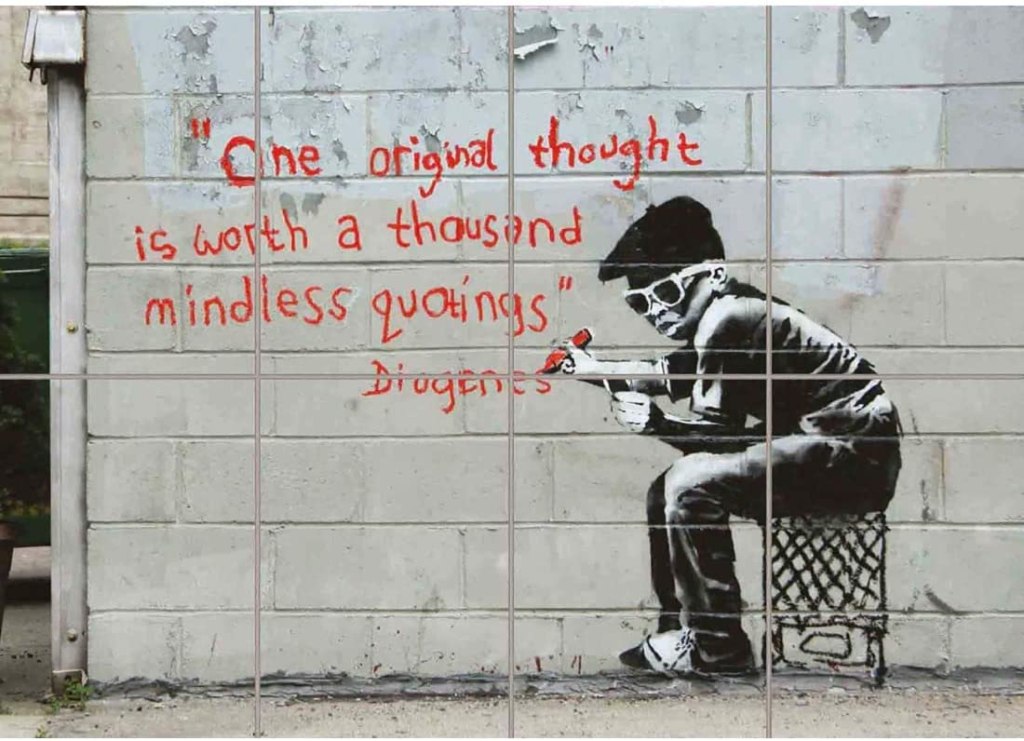
The Postmodern period in English literature (1945 on, maybe) is typified by REPRODUCTION. Postmodern artists multiply the surfaces modernists wish to look behind; “postmodern play,” whether exuberant or exhausted, is insistently referential.
Important note: Postmodernism is a contested designation. Persons on the left and the right reject the “cultural logic,” albeit for different political reasons, and a growing number of literary critics (of various political persuasions) are of the opinion that modernism never really ended. Additionally, the totalizing term can obscure the ways in which the “Break-up of Britain” has resulted in a “worlding” of a globalized English literature. That said the almost overwhelming drive to define a dominant “postmodern”–especially in the late 80s, 90s, and early 2000s–warrants this separate consideration in our survey of British literature.
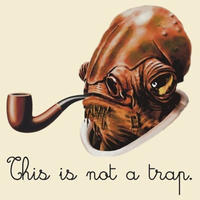
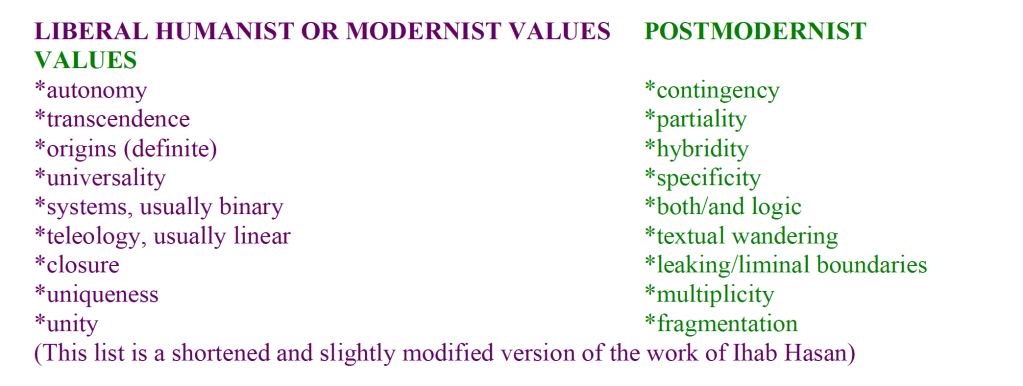
Expect the unexpected (because the norm is to oppose norms): Even though postmodernism rejects simply binary systems, it is best understood in opposition to modernism. This is as an example of the inherently contradictory nature of postmodernism. (Note: the “modernism” being opposed here is the trajectory of western thought from the Enlightenment on, not just early 20th-century trends.)
Crisis in representation: Realist and modernist fiction both depict comprehensive realities, and use language as a vehicle for comprehension. Readers can visualize Leopold Bloom’s carnivalesque nightmare in Ulysses as readily as they can picture Jane Eyre looking in a mirror. Postmodern texts frustrate representation by calling into question signifying systems. Gertrude Stein’s Ida shows images of images (with demonstrably no “real”). Jeanette Winterson’s Sexing the Cherry has a figure–the Dog Woman–who literally cannot be visualized, and Caryl Churchill’s Cloud 9 confounds sight and experience through the exploitation of cross-casting and prop manipulation to stage an impossible “reality.”
Depthlessness: If modernism can be typified by an increased concern with the interior (by psychological depth), then postmodernism can be typified by superficiality. Mrs Warren’s Profession is a careful study of human behavior/motivation; such “depth” is lost when we get to the work of Samuel Beckett. Not only do we not know who/what Godot is, we are unsure of Vladimir and Estragon’s motivations, as well as their previous histories.
Pastiche: A pastiche is a composition (musical, artistic or literary) that is made up of bits and pieces from various other sources. Pastiche (like its related term, parody) can be used to ridicule the work of another artist/composer, but it is more often than not a general borrowing of styles. Due to the loss of personal style, and the realization that everything is made up of multiple discourses, pastiche has come to dominate postmodern modes. Postmodern artists openly flaunt the idea that their work is not original, unique, or singular (see the Banksy image above). Most, if not all, of Tom Stoppard’s and Timberlake Wertenbaker’s dramas, and Peter Ackroyd’s, John Fowles,’ and A.S. Byatt’s fictions, can be considered clever pastiches.
The deconstruction of the “Truth”: The Enlightenment project may have striven toward transcendent truth, and may have seen the answers to time-honored questions imminent on the horizon, but postmodernism rejects such totalizing gestures. “Master narratives” (or broad ideologies that help to explain the shape/structure of society, identity, thought) are breaking down. For example, modernism may have taken great stock in Freudianism, Marxism, or the natural sciences, but postmodernism sees these far-reaching theories as merely contingent, partial, and subject to variation (or even negation) on the basis of “location” (culture, race, gender, geo-political locale, etc.). Postmodern literature is notorious for offering differing, alternative, and often contradictory versions of the truth, c.f., Salman Rushdie’s Moor’s Last Sigh, Julian Barnes’ Flaubert’s Parrot, Terry Johnson’s Hysteria, or Margaret Atwood’s The Blind Assassin. (A formal instance of this deconstruction: B.S. Johnson’s The Unfortunates presents its loose leaf manuscript as a “book in a box” that readers can order in any way they wish.)
The abolition of critical distance: The reason there is no one truth is because postmodernism has recognized that there is no objective or removed space from which this truth can be gauged or tested. (Measurement always disrupts the experiment.) It is commonly believed that peoples’ own moral, political, and philosophical values color their judgments. “Shocking” drama, such as Edward Bond’s Saved or the orgiastic violence Sarah Kane’s Blasted, works precisely because it allows no critical distance between the audience and the terrors represented on the stage; as a result, it seems to offer no objective moral position from which the represented atrocities can be denounced. Ian McEwan’s Atonement strives to instill a morality, but it can only do so through fictionalizing and implicating the “author” of the tale herself.
Ontological concerns: If truth is not fixed, then neither is reality, for different versions of stories can create the possibility of different worlds. Science fiction and fantasy are the predominate genres in contemporary literature (especially in the British tradition, where the mid-century masterworks of Orwell, Huxley, Tolkien, and Lewis are followed by Douglas Adams’ Hitchhiker’s guides, Terry Pratchett’s Discworld series, and J.K. Rowling’s Harry Potter juggernaut). And ontological questions are no longer reserved for so-called “genre” fiction: the experimental works of Christine-Brook Rose and the Nobel Prize winning fiction of Kazuo Ishiguro (c.f. Never Let Me Go, The Buried Giant, and Klara and the Sun) traffic in alternate realities.
Breakdown between High and Low art: (Duchamp and his damn toilet!) If truth and reality are no longer fixed, then neither is art. What is to say that references to Darth Vader aren’t just as valid or “learned” as quotes from Milton (not the toaster) or allusions to Dionysus? Critics are no longer just looking at how Joyce “used” romance conventions in the Nausicaa chapter, they are studying romance novels themselves. Erstwhile comics are now graphic novels, granted academic recognition (witness the current reception of Neil Gaiman and Alan Moore).

 Helga's Hub