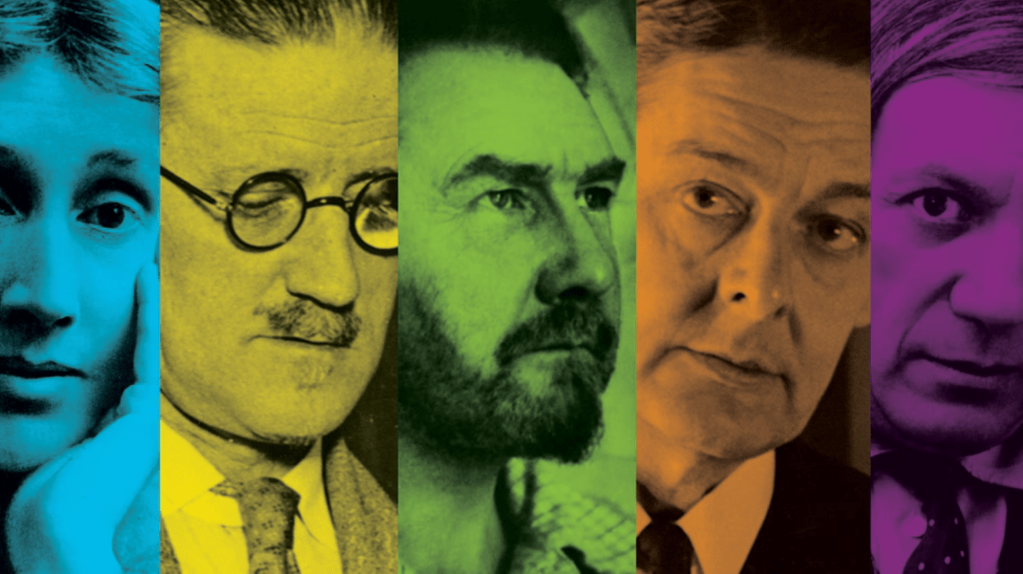
The Modern period in English literature (1900-1945 or 1965) is typified by the need for RENEWAL. Modern artists rejected the Victorian focus on reform, favoring interior retreats designed to facilitate cultural regeneration in the wake of WWI.
There is debate as to when modernism *officially* began (was it 1890, 1900, or 1910?), and some suggest that it never ended (a number of scholars now consider “postmodernism” a late configuration of modernism itself), but there is widespread agreement that Anglo-American literature in the first decades of the 20th century is typified by self-conscious aesthetic experimentation, cosmopolitan yearnings, and psychological explorations.
THE WAR: The effects of World War I (or the “Great War,” as it was called) cannot be overstated. Although much of the canonical work of High Modernism does not refer directly to the war itself, the effects of the war are rendered symbolically in almost every text. Eliot’s “waste land” registers the “no man’s land” of trench warfare, Ulysses (significantly set before the war) alludes to Home Rule agitation in Ireland, and Lady Chatterly’s Lover and Mrs Dalloway include wounded veterans as pivotal characters. These artists may have left the descriptions of slaughter and carnage to reporters and poets on the frontline, but they limned the deleterious effects of global conflict on the modern mind and cosmopolitan ideals.
FORMALISM: Modern artists frequently valorized form over content. This focus on style, though, did not mean that the moderns were wedded to generic conventions. The poetry of Eliot, for example, radically broke with the predominantly narrative mode of Victorian verse. Virginia Woolf urged authors to reject un-natural and artificial conventions, and the premier novel of the era (Jame Joyce’s Ulysses) incorporates various modes, linguistic registers, and generic conventions in successive experimental chapters. Plot, as it had been conventionally conceived (with a beginning, middle, and end), was largely ignored in favor of impressionistic vignettes that expressed a mood, emotion, symbol, or sense.
COSMOPOLITANISM: Rejecting the jingoism that led to the disastrous World War, modern artists and intellectuals fashioned themselves “citizens of the world.” The period is filled with expatriates and exiles who congregated in metropolitan meccas like Paris. Whereas Victorian writers differentiated themselves from their American counterparts, modern writers forged aesthetic solidarity in what we now recognize as an Anglo-American iteration of modernism.
PRIMITIVISM: Primitivism is the belief or doctrine that “primitive” (indigenous or “native”) peoples are nobler than their more “civilized” brethren because they remain closer to nature (and hence have not been corrupted by the negative influences of modern society). The doctrine of primitivism was first advanced in the 18th century by the writings of Rousseau, but it gained wide intellectual acceptance in the 20th century. Artists recoiling from the mechanization of life, the triumph of materialism, and the horrors of the Western Front, returned to the primitive to resuscitate a degenerate and corrupt Europe. Darwin’s theories of evolution, Freud’s notion of the subconscious mind (and Jung’s theory of the “collective unconscious”), Sir James Frazer’s pioneering study of ancient mythology (The Golden Bough), and plundered art displayed in imperial metropoles all set the stage for the triumph of the primitive in the early 20th century.
ALIENATION: In the 19th century, the German intellectual Karl Marx contended that contemporary life was typified by alienation. Capitalism had advanced in such a way that workers, who had been moved from a form of cottage industry, over which they had control, to a factory system, in which they became a cog in a machine, had become alienated from the means of production. Although there were artists and intellectuals who espoused Marxist ideals (such as the German playwright Bertolt Brecht) and were initially sympathetic to the Soviet state (the Irish dramatist G.B. Shaw), most moderns merely borrowed the concept of alienation and reworked it to define their own feelings of (often privileged) isolation from society (and inherent rejection of the middlebrow masses).
THE UNCONSCIOUS: Psychoanalysis is a system of psychology originated by Sigmund Freud in the 1890s. Focused on inner essences, thoughts, feelings, emotions, fantasies, and dreams, it sought to understand the effects of the subconscious on the conscious mind. Freud’s theorization of the unconscious had a profound impact on the moderns. Many authors not only knew Freud, but had been psychoanalyzed by him as well. The “interior” focus of modern literature can be seen in everything from the new emphasis on character motivation in modern drama to the complex delineation of voice in modern poetry. It is particularly pronounced in modern fiction’s aesthetic innovation: stream of consciousness.
THE SPACE-TIME CONTINUUM: Until the mid-19th century, time was largely a local phenomenon, as each area or region marked its passage in relation to the local environment. The railway system changed all of this. In the beginning of the 20th century, the world, quite literally, came to occupy a unified space of measured “standard” time. Not coincidentally, time, as a measured reality and a theoretical concept, factors heavily in modern literature. Whether it’s represented in Eliot’s bartender calling “HURRY UP PLEASE IT’S TIME,” Faulkner’s Quentin Compson musing over his pocket watch, or Woolf’s evocation of the “leaden circles” issuing from Big Ben, modern literature seems obsessed with observations of measurable time. This “clock time” is frequently contrasted with the psychological experience of time (c.f. Henri Bergson’s theory of durée)
THE WOMAN QUESTION: The suffragettes prevailed in the modern era, when women were finally given the right to vote (first in America then Britain). This successful political movement sparked quite a few cultural fears and trends. Of most concern was what the so-called the “New Woman,” the independent (usually suffragette) woman who rejected the conventional role that Victorian domesticity had thrust upon her. Canonization has proven far kinder to fictive representations of the “New Woman” than women authors. Although many female writers of the modern period were critically acclaimed by their modernist brethren, the Anglo-American modern movement came to be defined by “the men of 1914.”
Bonus Chronology
Because the 20th century can get very confusing in terms of classification, I thought a brief chronology of defined periods could help. Each one of these designations can be (and has been) used in conjunction with modernism.
EDWARDIAN PERIOD (1900-1914): named for Edward VII, who ruled from 1901-1910. This period is commonly perceived as the “realist” phase of British literature. Although technically part of literary modernism, this period is often differentiated from the era of so-called “high modernism.”
GEORGIAN PERIOD (1914-1940): named for George V, who ruled from 1910-1936. This period is rife with aesthetic experimentation. It is often typified by the so-called annus mirabli, 1922, when both “The Waste Land” (the premier poem of the modern period) and Ulysses (the premier novel) are published. Although associated and often conflated with “high modernism,” this period also encompasses the Thirties, a decade and a literature whose commitment to politics and social causes was anathema to the aesthetic removal of the modernist intellectual. To make matters even more confusing, the classification of “Georgian” is often applied to “non-Modernist” literature up to and including WWI (in other words, the poetic definition of Georgian often encompasses the Edwardian period).
AGE OF DIMINISHMENT (1945-1965): According to William Holman and C. Hugh Harmon’s Handbook to Literature, this period saw the steady wane of British literature. Save the late modernist/proto postmodernist work of Samuel Beckett and the sharp satire of George Orwell, this era is typified by a disillusionment with the “condition of England” and with a staunch return to the realist form.
POSTMODERN (1960 or 65-present): Postmodernism is a highly contested concept, but the term has gained wide enough acceptance to warrant inclusion here. According to most critics, literary postmodernism denotes an aesthetic trend that is typified by irony, pastiche, and a break-down between “high” and “low” art. In many ways, it is indebted to the earlier movement of modernism (see Georgian above), but unlike modernism, it is aware of its own limitations and refuses to rely on the concept of universality or venerate the cult of the author.
POSTWAR (1945-present): As noted in the blurb on the “Age of Diminishment” above, British literature is often seen to be on the wane after World War II because many British authors rejected the stylistic and aesthetic impulses of modernism (impulses still extant in postmodern forms) and instead returned to “older” forms of literature. Because postmodernism is not considered the dominant trend of contemporary British literature (in a way that it is considered the dominant in American), some scholars choose to label British literature from 1945 to the present with the more general chronological classification of “postwar.”
 Helga's Hub