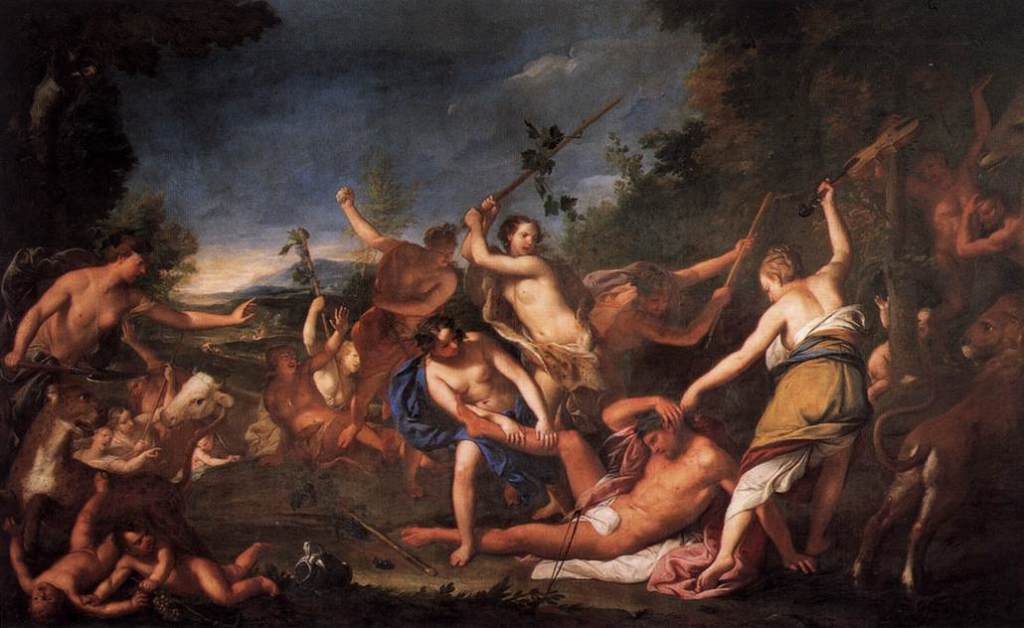
The theme of our course is “sparagmos.” Our illustrated Adobe Spark presentation defines this term and provides an overview that draws upon our readings. Along the way, the presentation more than suggests that the “divine fury” of the maenads remains very relevant to our modern era.
Of most interest to burgeoning English scholars should be the academic analogue the violent rites of Dionysus offer our degree program. English Studies itself has undergone its own disciplinary dismemberment in order to be reborn in the digital age. We will explore this apparent rebirth in our review of “digital tools” and our analysis of the adaptive treatments of widely circulated texts.
All in all, our thematic focus will divine a “purpose” for our chosen program of study (English) by explicitly articulating why we study what we do. And, as we undertake this curricular ritual, aided by Socrates, we should be able to secure the rhetorical prowess we’ll need to justify our professional worth in any interview or workplace setting!
{{{an academic apéritif}}}
Understanding the stories humans tell themselves is no dilettante distraction; it is a productive endeavor that formulates the very “meaning” that secures society. And we can look to none other than the “father of modern capitalism,” Adam Smith for proof of this: his delineation of the market is undergird by a narrativized theory of “moral sentiment,” not a now dead metaphor of a “free hand.”
{{{a disciplinary digestif}}}
Don’t let dirges in the popular press distract you–English Studies isn’t dying because there aren’t enough teachers clapping our very own Tinkerbell (Shakespeare) to life. Shakespeare gets plenty of attention (as this course itself shows), and the canon actually has to modulate over time to account for the circular “progress” of tradition and individual talent.
Now this doesn’t mean that English Studies will survive in perpetuity. The bulk of what we study will prove remarkably resilient (as the presence of Plato, Euripides, and Shakespeare on our syllabus shows), but how we study (and what we call our area of study) will necessarily evolve (hello digital humanities!) as we consider our growing corpus (which now rightly includes Toni Morrison).
What we should remember: the study of literature is itself an outgrowth of Biblical exegesis, and this secular scholarly pursuit has already shifted from a scrutiny of ancient texts (primarily Greek and Latin) to important works in vernacular languages (vernacular defined here as a modern language that evolved from an ancient root). The important conversations people are having in Classics, prompted by the influential work of Dan-el Padilla Peralta, are only possible because new “bodies” have grown out of the ritualized dismemberment of a once unified object of study: classical education.
And English Studies is itself a part of this divine rebirth.
Our discipline is only an epigone of classical pursuits if we collectively decide Latin (or ancient Greek) grammar is inherently superior to literary analysis. The thoroughly “modern” subject of English did not “kill” any language (or object of study). It maintains lexical life by carrying the rhetorical flame into the present age. . .
 Helga's Hub