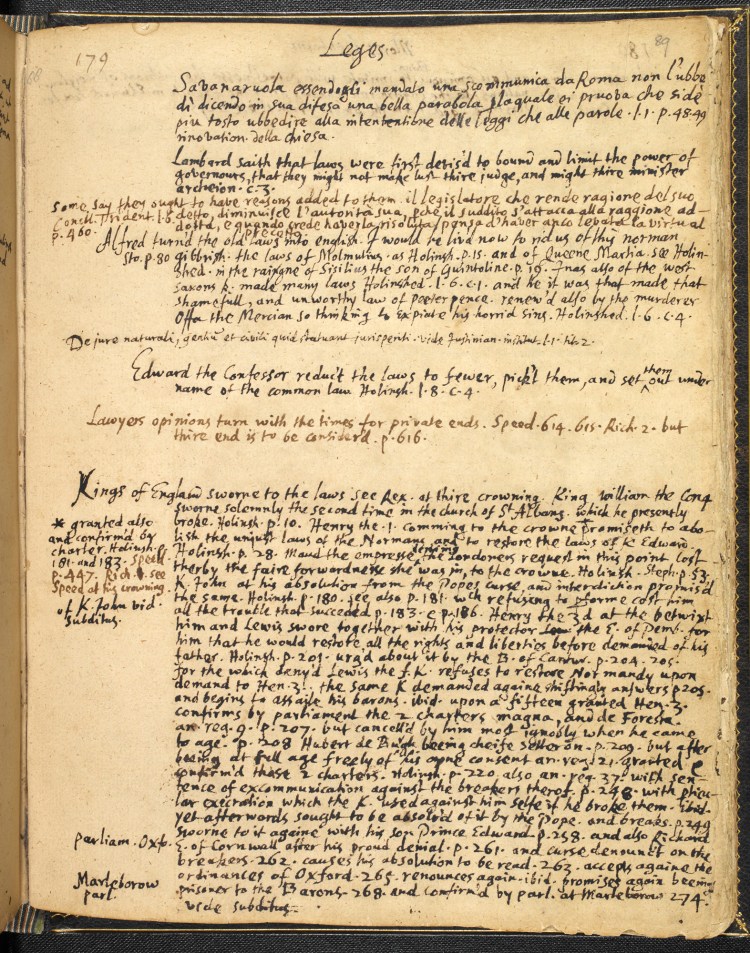
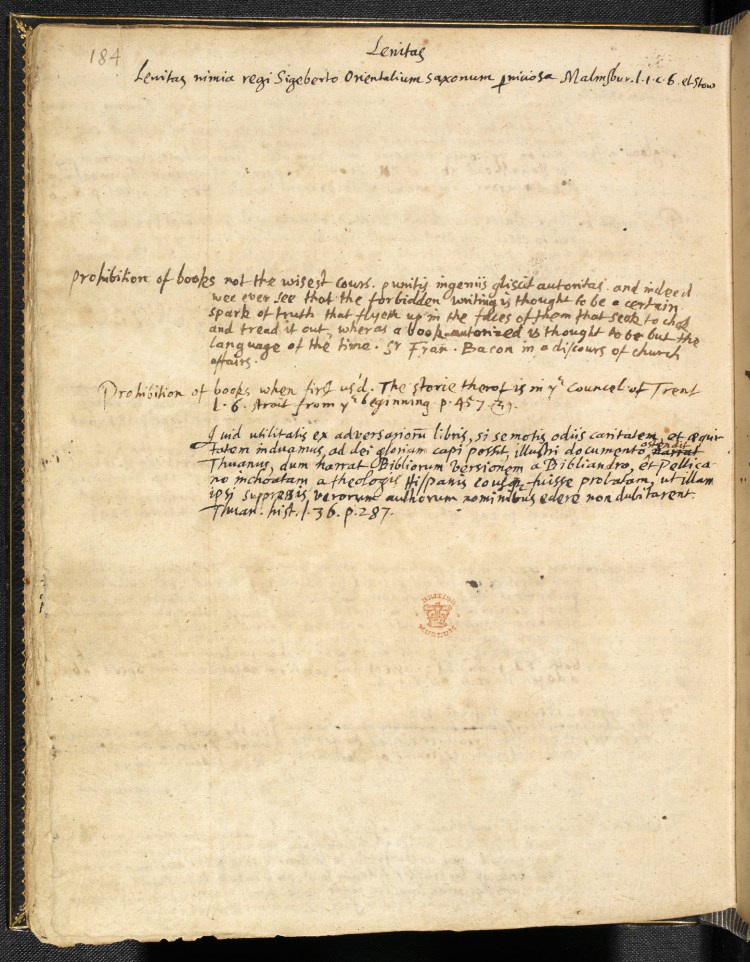


What we tend to consider the relatively distinct practices of scrapbooking, journaling, and note-taking today were combined by engaged readers in the past, who kept personal inventories of the ideas, expressions, and quotations that would fuel their creative work. These personal inventories, termed “commonplace books,” proved such important pedagogical tools that 17th-century students at Oxford were instructed in “commonplacing.” John Milton, Sir Isaac Newton, Thomas Jefferson, and Virginia Woolf are just a few of the notable authors who kept commonplace books. (Note: the slideshow above includes images of pages from Milton’s commonplace book, courtesy of the British Library)
Because we don’t want 17th-century English students (or Milton for that matter) to have all the fun, we’ll be keeping a commonplace book of our own this term, one designed to outline our career goals and interests.
Every week, you’ll be expected to identify 3 or 4 passages, images, or other multimedia materials from your current coursework that you find intriguing and thought-provoking. The material can come from any of the classes you are enrolled in this term (you are not required to select material from ENG 499c, although you obviously may do so). What matters is that the identified passage, image, or multimedia is somehow significant to you.
This information should be compiled in a “draft” document or folder that includes (a) the course of origin and (b) the citation for the material itself (i.e., how you would cite the work in an MLA style Works Cited page).
At the end of the semester, you will submit your curated compilation in a thematically organized Word document, pdf, Sway, PowerPoint, or Adobe Spark presentation that articulates your career interests and goals. Each collection must be accompanied by a 500-word “annotation” that outlines how these interests will help you craft the professional persona you wish to present to prospective employers. (In other words, you’re going to treat this semester as a synecdoche of your degree and make a case for the skills, dispositions, and knowledge you’ve gleaned through the advanced study of English.)
The 100 points available for this assignment, which will serve as the final for the course, will be awarded based on accuracy and articulation. Curated materials must be properly cited (this means there will be a final Works Cited page for all Commonplace books–hyperlinks, like the one offering image attribution above, will not be enough in the polished product you are to present). They must also be presented in a way that makes professional sense. The specific selected passages, thematic categories, parameters of organization, and choice of presentation format (Word doc, pdf, PowerPoint, Sway, or Spark) are up to you. The only prescription is that your 500-word “annotation” articulates a professional ideal in a carefully edited work of expository prose.
And, before you get too worried about what you will include and why, remember: we are spending the entire semester making a “career case” for our degree–and drafting a professional portfolio to systematically organize our academic experiences. This means that we have many opportunities to define what we do as English majors before the final project/presentation.
So don’t make a hell of heaven, or labor under the delusion that this is darkness visible. Our course “final” is really just your opportunity to show me how you can present what you’ve learned this semester in ways that highlight your career readiness!
 Helga's Hub