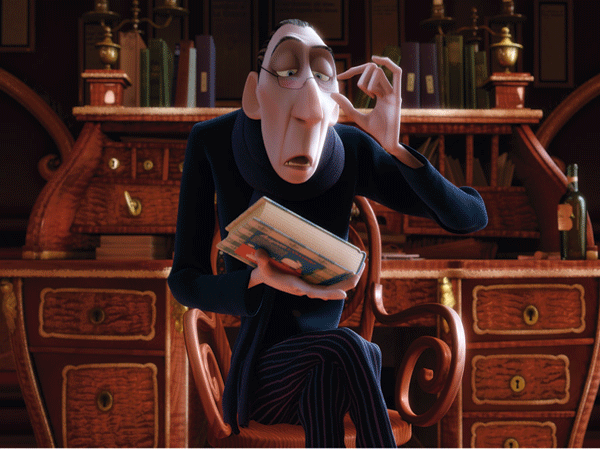
One of the biggest misconceptions I deal with in introductory classes (literature or film) is that “appreciation” has to equal “liking.”
Now my students, despite their sly claims to the contrary, are well aware of the fact that formal study requires both knowledge acquisition and the deployment of proper terminology. Many, though, sadly operate from the assumption that the consideration of art as a(n aesthetic) construct somehow constrains enjoyment–either by sucking the life out of the object/artifact/phenomenon altogether or by so circumscribing what is acceptable in terms of engagement that the inevitable result will be a disembodied “taste” imposed by a newly acquired palate.
This isn’t true–or, perhaps more correctly, doesn’t *have* to be true–as the Pixar film Ratatouille (2007) shows. Anton Ego begins the film as a perfect stereotype of the pretentious and priggish critic, incapable of even tasting that which he purports to love, but he ends the narrative reconnected to his earliest passions, able to amplify talent precisely because he understands (and can articulate and properly value) all of the ingredients that factor into culinary greatness. If there weren’t a range of unforced errors in the conclusion (health inspectors visit bistros as well as Michelin-starred dining establishments, and the final use of “rat” as a verb is more confusing than clever), Pixar’s film could stand as an “appreciation” argument on its own. As is, the somewhat muddled ending requires a bit of a coda–which I’ll supply via my own wary considerations of opera.
For the record, I don’t like opera. It could be I was dragged to far too many shows when I was a child; perhaps I need some (or any!) dialogue in musical theatre to experience a glimmer of delight; or maybe, just maybe, I prefer my elaborate and bombastic displays of emotion in silent productions that are filmed. Whatever the reason, opera does not spark joy for me.
This does not mean that I find nothing redeeming in opera. Like most people, I can and do respond to famous arias–“Habanera” (Bizet’s Carmen), “O mio babbino caro” (Puccini’s Gianni Schicchi), and “La Donna è Mobil” (Verdi’s Rigoletto) are crowd pleasers for a reason–but many of my personal responses are conditioned by other associations. I have a fondness for “Vesti la giubba” (Pagliacci), for example, because it conjures the the death of Malone in The Untouchables, the strange delights of “The Two Faces of Squidward,” and the magical, murderous machinations of Sideshow Bob.
That said, I do appreciate the totality of the musical theatre I was forced to experience as a child, sitting hour after hour in a stuffy auditorium, reading playbills to pass the time. The fact that I couldn’t wait for Madame Butterfly to breathe her last doesn’t mean I was insensitive to the effect that that fictional death had on other members of the audience. The music, which I found too loud and overbearing (did I mention my father secured season tickets in the *front row*?), was admittedly an appropriate vehicle for the emotional excess on stage. As annoyed as I may have been with the anguished cries of “Tu? Tu? Piccolo iddio!,” I could actually feel the symphonic crescendo inside me. The viscerality of the vibrato would never have offset my distaste for the storyline, but it did allow me to understand why others might be moved by this stereotypical rendering of suffering in song.
And it is not as though I experienced existential ennui every production. One of the operas I came close to enjoying was The Magic Flute, a fantastical tale marred by (in my estimation) an unduly long running time. I’ll admit the younger version of me was initially thrilled that there were characters just speaking on stage, but none of that really mattered when the Queen of the Night sang her famous aria:
Odds are, even with intense and purposeful study, I’ll never be able to fully explain how or why a human singer, mimicking a flute, is so deeply menacing on stage. All I know is that this registered on me when I was a child, and I responded to that energy, even before I learned the mother was exhorting her daughter to assassinate Sarastro. (In retrospect, what a wonderful contrast to Madam Butterfly. No sense fussing over an Ophelia when you can watch Lady Macbeth!)
Admittedly, neither my dawning awareness of the power of metrical composition, nor my growing understanding of opera’s place in history, facilitated real enjoyment of this theatrical form. (The highlight of every performance was always the family trip to Rudy’s Hot Dog after the curtain fell.) My repeated exposure to the stylized expression, though, granted me the opportunity to indirectly determine what I genuinely valued in art. The amazing costumes and over the top make-up were elements I adored, alongside the accoutrements that served an oddly practical purpose (what other art form has its own slipper and glasses?). The fact that I most admired pictures of the likes of Maria Callas, though, let me me know that I preferred staged tableaus devoid of distracting noise. (I often experience contrapuntal composition as a form of aural aphasia.) And even the pointless bombast of Aida reminded me of my genuine love of extravagant drama. I’d just rather this grandiosity be expressed in genres that self-consciously exploit bodily excess (such as horror) or narratives that focus on actual character development. (Showcasing histrionics for style points [colortura] isn’t adequate characterization in my book.)
That said, were it not for the broad popularity (and storied history) of opera, musical theatre (including the contemporary musicals I favor) would not be what it is today, W.H. Auden (one of my favorite poets) would not have been able to reconceive the “literary” by writing librettos while he pioneered the “pylon school,” and a host of individual works that I admire would have no material basis for existence. M. Butterfly and Amadeus don’t just draw upon historical figures related to operas; they construct fictional storylines that are operatic in and of themselves. Gaston Leroux’s tragic Phantom can’t haunt any old theatre or house–his special situation requires an opera. While scenes in The Shawshank Redemption or Apocalypse Now would be undeniably diminished without the presence of opera on their soundtracks, Hwang’s play, Shaffer’s stage production (which is now impossible to think of outside of Foreman’s film), and Leroux’s novel (and hence Webber’s musical) would cease to exist.
Opera may not be my cup of tea, but it that doesn’t mean I can’t drink it, or notice how its flavors complement those of the beverages I actively choose.
Most importantly, in terms of the coda I am attempting to craft here, my hard won appreciation of opera has refined my palate without fundamentally altering my taste. I still get excited over a good chili dog, and “The Rabbit of Seville” remains my favorite incarnation of opera (Mozart or otherwise). My expanded aesthetic awareness–which now includes a *very basic* understanding of opera–just allows me to be more confident in my (informed) assessment of this amazing cartoon. And that’s downright delicious.
 Helga's Hub