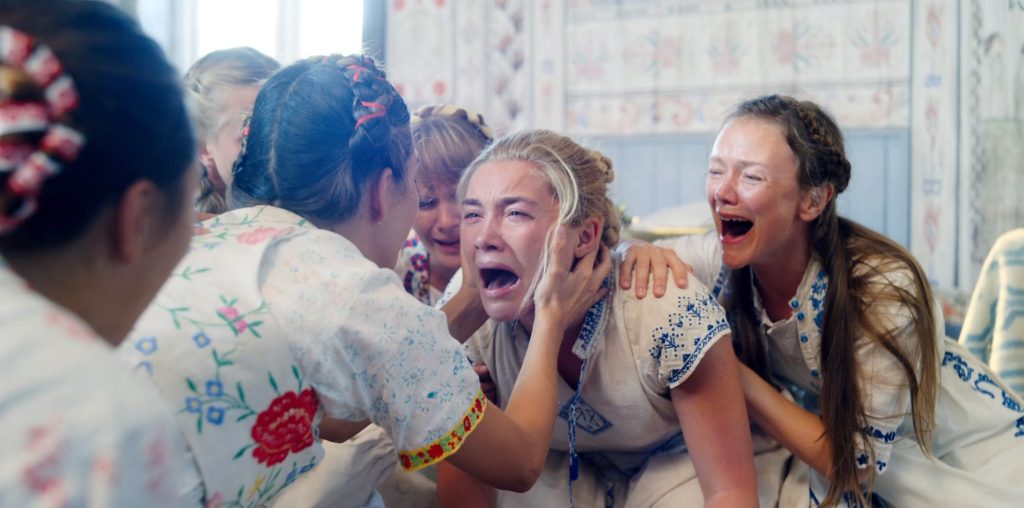
When I first saw Midsommar, visions of Alfred Lord Tennyson’s In Memoriam danced in my head.
In my defense, the film’s protagonist, Dani, does spend a majority of the movie as
                An infant crying in the night:
                An infant crying for the light:
            And with no language but a cry.
And her exhaustive journey through prolonged grief just so happens to conclude with a formal village celebration, wherein her “genial spirit,” not having “shunned” the libation placed before her, “meet[s] and greet[s] a whiter sun”:
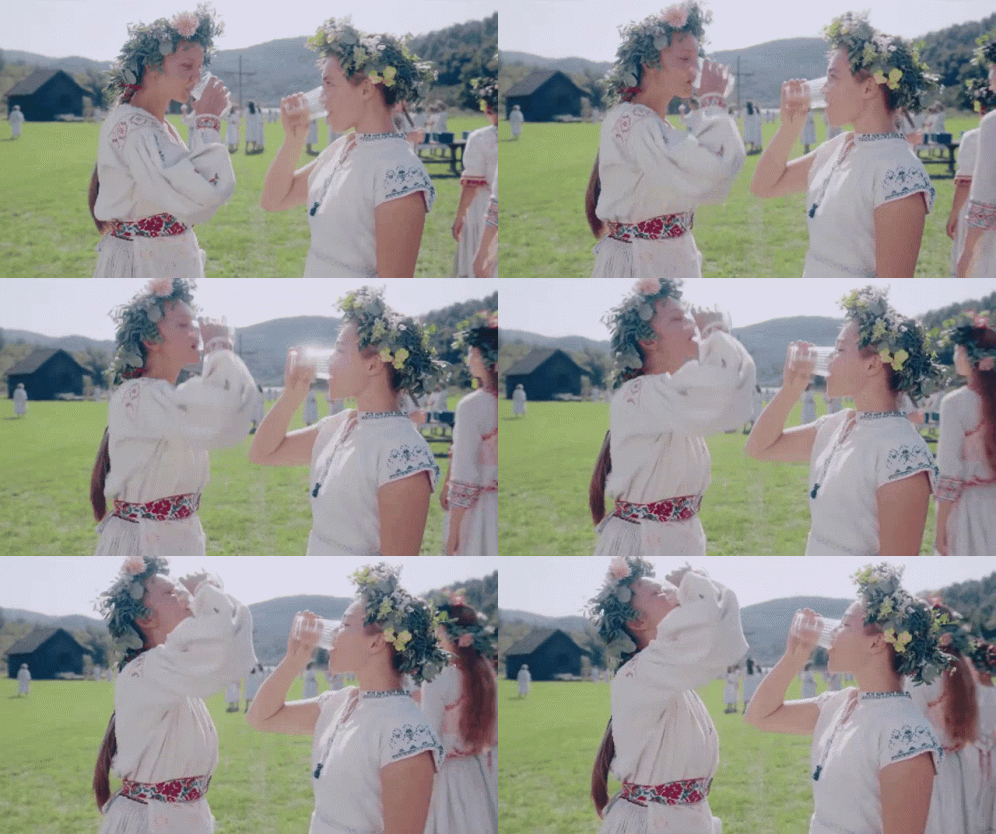
The fact that I probably need to be more “careful of the type” (Tennyson’s Victorian verse ultimately affirms Judeo-Christian belief; Aster’s contemporary cinema purposefully immolates its Christian), doesn’t obviate the power of connection in this evocative film. The magic of Midsommar is that it can seemingly signal so much while it renders darkness visible.
Going through a bad breakup? Midsommar is a movie for you. Intrigued by the monstrosity of mourning? Watch Dani weep (preferably after you’ve already lived through the disturbing experiences of The Babadook [2014] and Aster’s earlier feature, Hereditary [2018]). Have a piqued interest in the “bloody chamber” of folk tales thanks to the likes of Angela Carter? Then check out this obliquely gynocentric reimagining of The Wicker Man (1973). Fascinated by cults? Or perhaps want a complex rendering of a psychotropic experience that doesn’t fall prey to the conventional morality of the “war on drugs”? Again and again, Midsommar is your film.
And why is Midsommar *my* film (aside from my rainbow connection to Tennyson)? Because its truly terrifying conclusion upends the usual logic of the gothic, crafting a compelling tale of horror peculiarly fit for our times.
In traditional gothics, the primitive forces that can neither be denied nor explained away are figured as monsters produced by the sleep of reason. We need look no further than The Wicker Man for proof of this. The villagers in Summerisle consciously reverted from reason when they stepped out of time, which is why modern audiences can still sympathize with the admittedly stuffy and priggish character of Edward Woodward. He may be a boring prude, but he is undeniably *right*: his death won’t bring back the apples. Such rational certitude is missing from the equivocal ending of Midsommar. Christian’s demise is also an atrocity wrought by unbridled superstition, but his immolation nonetheless brings a healing of sorts to Dani. And it is this “healing” that provides the film’s frisson terror, as it suggests that the Hårgan cult *could* be a “reasonable” response to the nightmare of modernity.
Admittedly, I’m far from the first person to note irrational rationality of Midsommar. Wisecrack’s surprisingly thorough overview offers a keen reading, replete with excellent illustrations. My (peculiar?) spin is the connection I see between this gothic inversion and illiberal trends in contemporary society.
Modern society (and the reason that purportedly undergirds it) is far from an unalloyed good Midsommar. The film insistently begins in a desolate cityscape and uses this this unremittingly dark frame to showcase the light that only grows brighter as Dani is transformed in pagan rituals that meld with the Swedish countryside.
Filmed in the low-key lighting typical of horror films, the initial scenes of Midsommar actually present America as an anonymous site of primordial darkness:
These cloistered compositions contrast greatly with the open frames of the Hårgan countryside. Suffused with a bright white light meant to meant to replicate the near omnipresence of the sun as summer solstice approaches, the shots of Sweden visually invite the audience in much the same way that the Hårgan people welcome their foreign guests–with a deceptive purpose hidden in plain sight.
While a number of commentators have noted the importance of Midsommar‘s symbolic cinematography, few have fully limned the uncanny narrative echoes that invite the audience to adopt Dani’s increasingly irrational perspective.
Like the denizens of Hårga, Dani has lived a life shaped by alternate ways of seeing of a “special child” (her mentally ill sister), yet she has only ever known this life in the confines of a nuclear family unit, where the specialness of her sister is considered a particular burden immediate relations and medical professionals must bear relatively alone. In contrast, the visions of the “special child” in Hårga, visions that would be linked to medically defined deficiencies and ailments in contemporary American society, are supranatural signs taken for wonders in the commune. And, as disturbing as some of these commune wonders may be, their meaningful presence offers a preferable alternative to the anomie of the selfish Americans in the film.
There is a reason Dani, in particular, is welcomed by this Swedish society, and why she (as a newcomer) is able to dance her way into the role of the May Queen. She is particularly ripe for integration, as Pelle always knew.
This almost preordained fit prepares us for Dani’s calm acceptance of atrocities we would (normally) hope any rational person would reject. Dani may be a denizen of the modern world, but the technological advances and stable political structures of her society did nothing to protect her from harm, and her graduate studies (in psychology, no less) provide no solace for her unrelenting grief. As we see in the brief glimpses of the time that exists before Dani knows of her sister’s final act, Dani did everything “right,” but none of this rectitude stopped the horrific event that would prove inconsequential to everyone but herself.
Within a rational society predicated on legally enshrined notions of individual liberty and autonomy, the spectacularly staged death of Dani’s family can only ever be seen as a shocking crime, one that will be recorded as a mere statistic. Within the confines of the Hårgan community, though, such a ritualized murder/suicide would be a carefully choreographed event, commemorated in such a way as to provide cultural cohesion.
Dani senses this, and so, on some primal level, do we.
This film never undercuts the shock of Hårgan rituals–the sickening thud of senicide is nothing short of disturbing–but that awful practice is still shown to serve a societal purpose, unlike the chaotic carnage created by Dani’s sister in the confines of her parents’ home. The film spends an inordinate amount of time focusing on meaning, and how it can be uncovered–only to determine that “primitive” Hårga have answers. The more “advanced” Americans do not.
The ultimate “relatability” and “understandability” of everything in the film, including Dani’s choice to stay during the most horrific events, are what render this gothic inversion so upsetting. Audiences don’t just get to see a troubled woman fall prey to a cult; they are lulled into an intoxicating identification of their own, encouraged to understand Dani’s actions while they are provided clear explanations for all of the brutal pagan rituals unabashedly performed in public spaces.
This identification is why memes such as this exist:
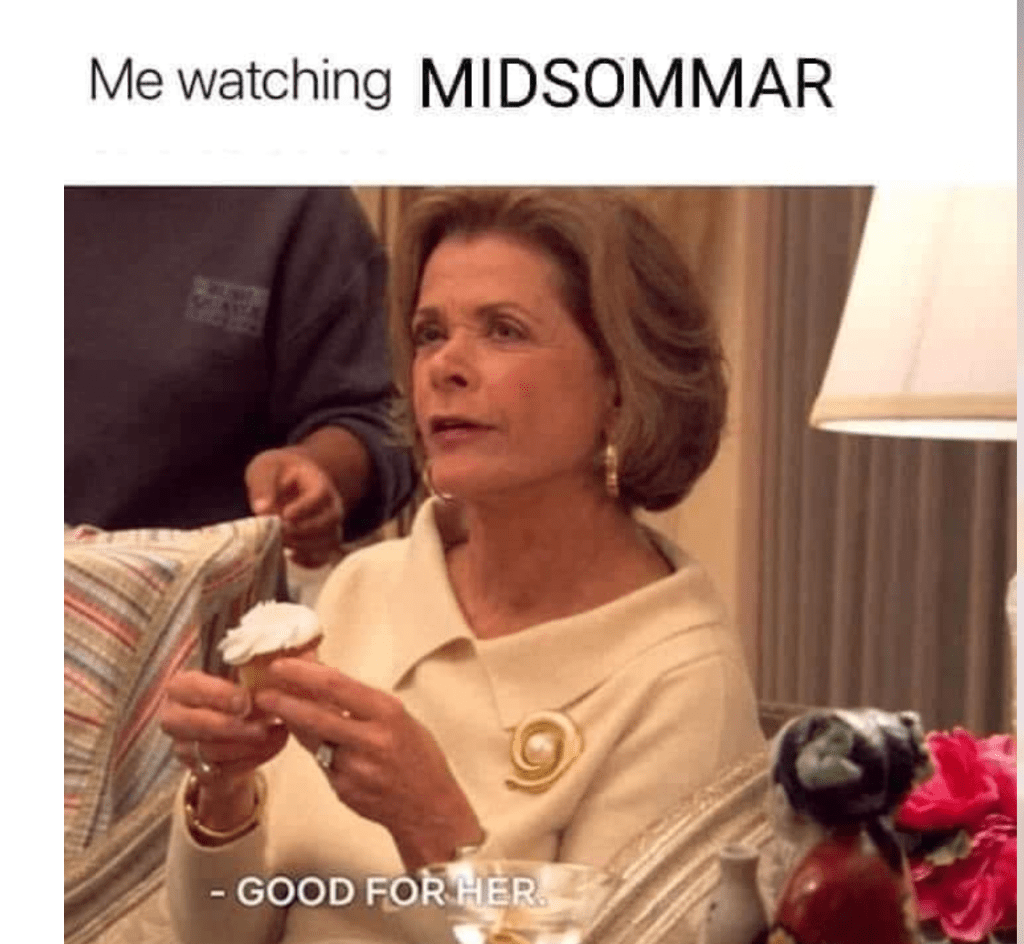
And this (over)identification with the irrational is what provides a chilling analogue to the illiberal arguments that present a violent rejoinder to a rational modernity in contemporary society.
In Why Liberalism Failed, the best known (and best selling) work of Patrick J. Deneen, the University of Notre Dame political scientist urges his audience to reject a modern society that “is shaping us into the creatures of its prehistorical fantasy, which in fact required the combined massive apparatus of the modern state, economy, education system, and science and technology to make us into: increasingly separate, autonomous, nonrelational selves replete with rights and defined by our liberty, but insecure, powerless, afraid, and alone” (p. 16). Deneen’s contention that the liberal order itself frustrates the “pursuit of happiness” it is supposed to allow (because it grants no preeminence to the sacred) is literalized in Midsommar‘s representation of a numinous north.
The individual freedoms Dani has in America do nothing to keep her from being “insecure, powerless, afraid, and alone” (Deneen p. 16). It is only when she rejects enlightenment reason and willfully embraces the traditions of Hårga that she is able to recognize that the (secular) Christian she had posited as her salvation is nothing more than a faithless cipher with no defined commitment of thought or purpose. She has to destroy this false idol of freedom in order to discover the happiness she might pursue in the highly structured religious community that embraces her anguish and celebrates her as one of their own.
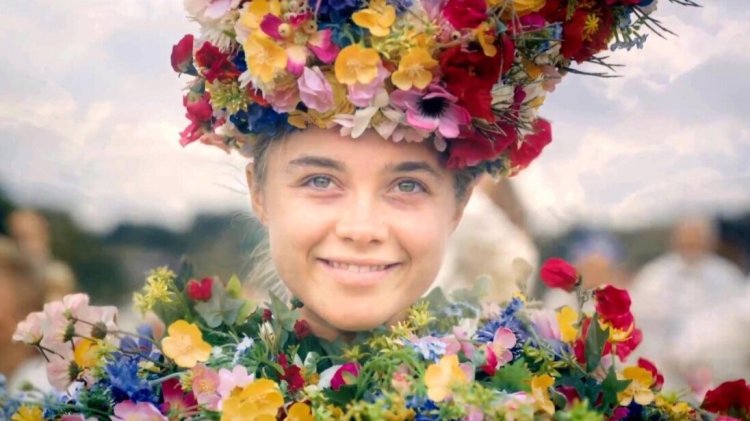
Dani’s clear distress as she ponders the fate of her chosen victim, followed by her enigmatic smile as she watches him burn, is functionally no different than Sohrab Ahmari’s (bad faith) case “Against David French-ism,” William Barr’s inexplicable campaign against “militant secularists” (who are destroying what he perceives as the “traditional moral order”), or Adrian Vermeule’s retrograde movement “Beyond Originalism.” Each is coming to the same terrible conclusion: that the only choice for disaffected denizens of modernity is the choice between anomie and illiberal animism.
And that’s goddamn terrifying.
 Helga's Hub